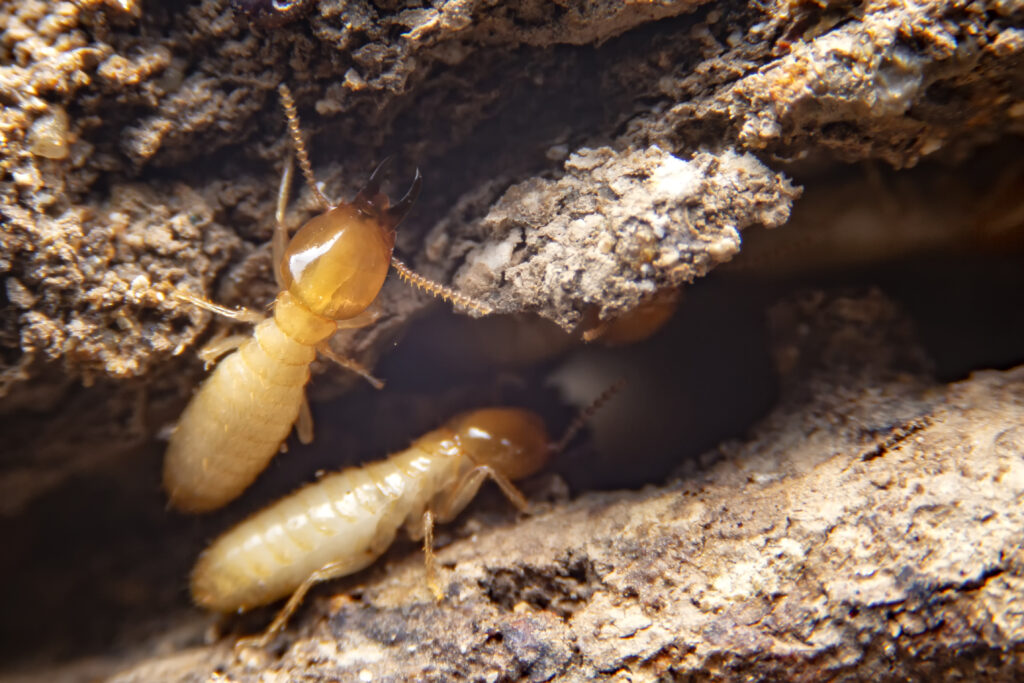
Termites are social insects that live in colonies made up of castes: a king and queen (reproductive), workers (colony maintenance), and soldiers (defense). They feed on wood and wood0based materials, thanks to microorganisms in their digestive tracts that break down cellulose.
TERMITES VS ANTS: Key Differences
- Antennae: Termites have straight, bread-like antennae; ants have elbowed antennae.
- Waist: Termites have no waist; ants have a narrow, pinched waist.
- Wings: Termites have equal-sized wings; ants’ front wings are larger than the hind wings.
Common termite species
- Drywood Termites
- Live in dry, sound wood (not soil-dependent)
- Small colonies that develop slowly
- Produce dry, pellet-like feces
- Feed across wood grain
- Common in dead trees, branches, brush and firewood
- Dampwood Termites
- Found in wood with high moisture content
- Rarely infest dry structural wood
- Cause damage if left untreated
- Feces are rounded, stuck together, or dissolve into a paste
- Subterranean & Mound-Building Termites
- Coptotermes spp.
- Most destructive species in Asia (80-90% of damage)
- Nests deep underground
- Attack wood, paper, and fabric
- Macrotermes spp.
- Largest termite species
- Build large mounds and cultivate fungus
- Feature major and minor workers/soldiers
- Also secrete a sticky liquid from the fontanelle
- Globitermes sulphureus
- Common in Southeast Asia
- Build earthen nests up to 1.5m tall
- Defend colony with suicidal autothysis (bursting bodies)
- Sodiers have yellow abdomens and large curved mandibles
- Microcerotermes spp.
- Small species (3.15-7.75mm)
- Build mounds or arboreal nests
- Fine, serrated mandibles
- Nests on posts or trees often reveal their presence
SIGNS OF INFECTION
- Mud Tubes: Earthy tunnels on walls or foundations
- Swarmers: Winged termites seen during reproductive flights
- Wood Damage: Hollowed or weakened wood structures
- Frass: Termite droppings (varies by species)
- Mounds: Visible above-ground nests, often near infested areas